

Starting my Substack
About Scotch whisky and its history

A Lil Bit Whisky
Hello! I’m Macon - that rhymes with bacon - I’ve been posting pictures on Instagram under the name A Lil Bit Whisky about my research on the history of Scotch whisky and now I aim to share that research here:
Why this, why now
Well, all that research time since 2019 was funneled into an extensive period of writing that culminated in my PhD thesis submission. Now that I have a little more free time I want to share what I have learned. I hope to turn my thesis into a book that is more widely available, but even though it weighed in at around 100k words there was still so much research that did not make it into the final draft. Plus, using Substack makes it possible to have my work available to those interested in whisky history and not just in an academic silo.

A PhD on Whisky?
Why, yes, that is a thing you can do. I got to spend a few years reading and examining pretty much everything I could get my hands on about the history of whisky and the development of the industry. My project was based in the Economic and Social History subject with the Centre for Business History at the University of Glasgow, in Scotland. The remit for the project was to investigate a way to explain the global success and popularity of Scotch whisky.
Two important parts required for a PhD are to utilise data for analysis that can be reproduced by others, this verifies the researcher’s work and tests that the same conclusions can be made and the thesis should make a contribution that furthers knowledge in the literature, so it is not just repeating what others have said. I chose to utilise printed pictorial advertisements for Scotch whisky that appeared in newspapers and magazines. This allowed me to construct a history of the development of these advertisements and examine how brands built equity and recognition, what the industry wanted to communicate to customers, and how this changed over time and for different regions.
More than a pretty picture
Histories of Scotch whisky have largely focused on the growth and decline of distilleries as well as the entrepreneurship of a few notable whisky brand founders. If you distill success down to the inherent qualities of the spirit and the good business sense of a few entrepreneurs this distracts from wider activity in the industry receiving scrutiny. This narrative has also served to emphasise Scotch whisky as a unique high-quality product that could sell itself. Yet, advertising became a necessary and active part of the business but one that has not been fully examined by business historians or whisky historians. A criticism that justifies why advertisements for Scotch whisky have not received academic attention is the compression of stereotypical iconography used to associate Scotch whisky with Scotland, think tartan, stags, and thistles. However, one of the key findings of my research is that while those representations were used they served a purpose and they changed to reflect different business conditions and that gives us context to the industry’s history.
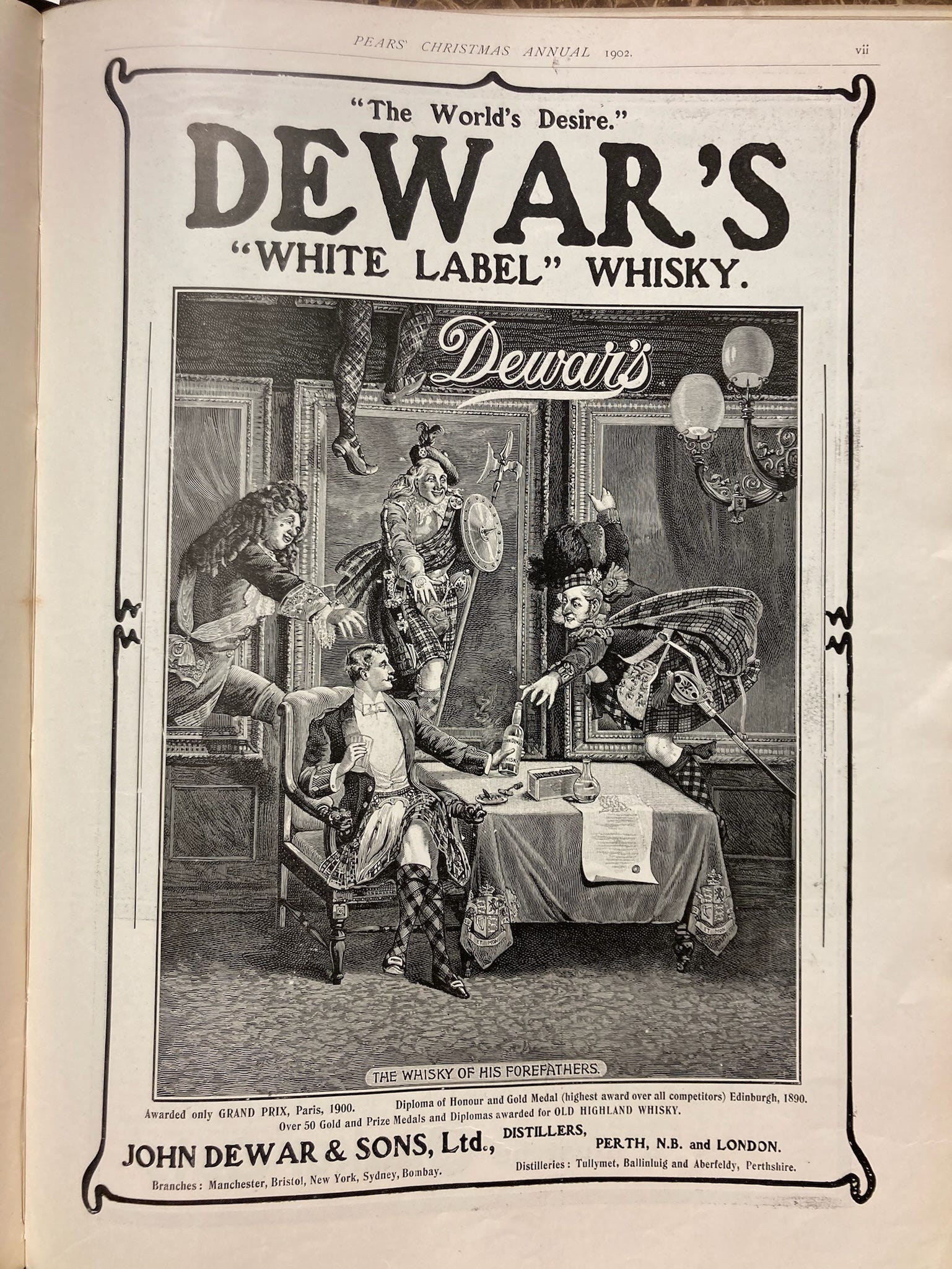
Advertising activity takes many shapes from promotional barware, and billboards, to printed advertisements. There is a surplus of past advertising ephemera that appears on auction sites, in personal collections, archives, and even museums - this is material culture and is now more widely recognised for contributing to social histories - understanding how “stuff” has impacted our culture and life in the past. With so much material and records by these companies not always surviving intact, it can be hard to construct an accurate timeline of this material for analysis. That is why I chose to utilise the advertisements in print magazines and newspapers which typically have a date on the page. Digitisation of these kinds of sources made it possible for me to easily collect effectively my own archive of Scotch whisky advertisements. Then I was able to step back and see the patterns that emerged and connect them to the context of what was happening in the industry.
In this way I was able to use advertising images as a source for analysis, to explain what the design choices communicate about the product, the brand, and the wider industry. Ultimately in each chapter, I could only really write about a few examples that helped move the narrative along revealing changes in the industry and demonstrating how different companies responded to emerging pressures. This has left me with a wealth of advertisements that did not make it into the thesis and I am desperate to share them with other people. If you’re interested in Scotch whisky advertisements, brand histories, and history of the industry I hope you’ll consider subscribing as I begin to share this research.
Research art journal
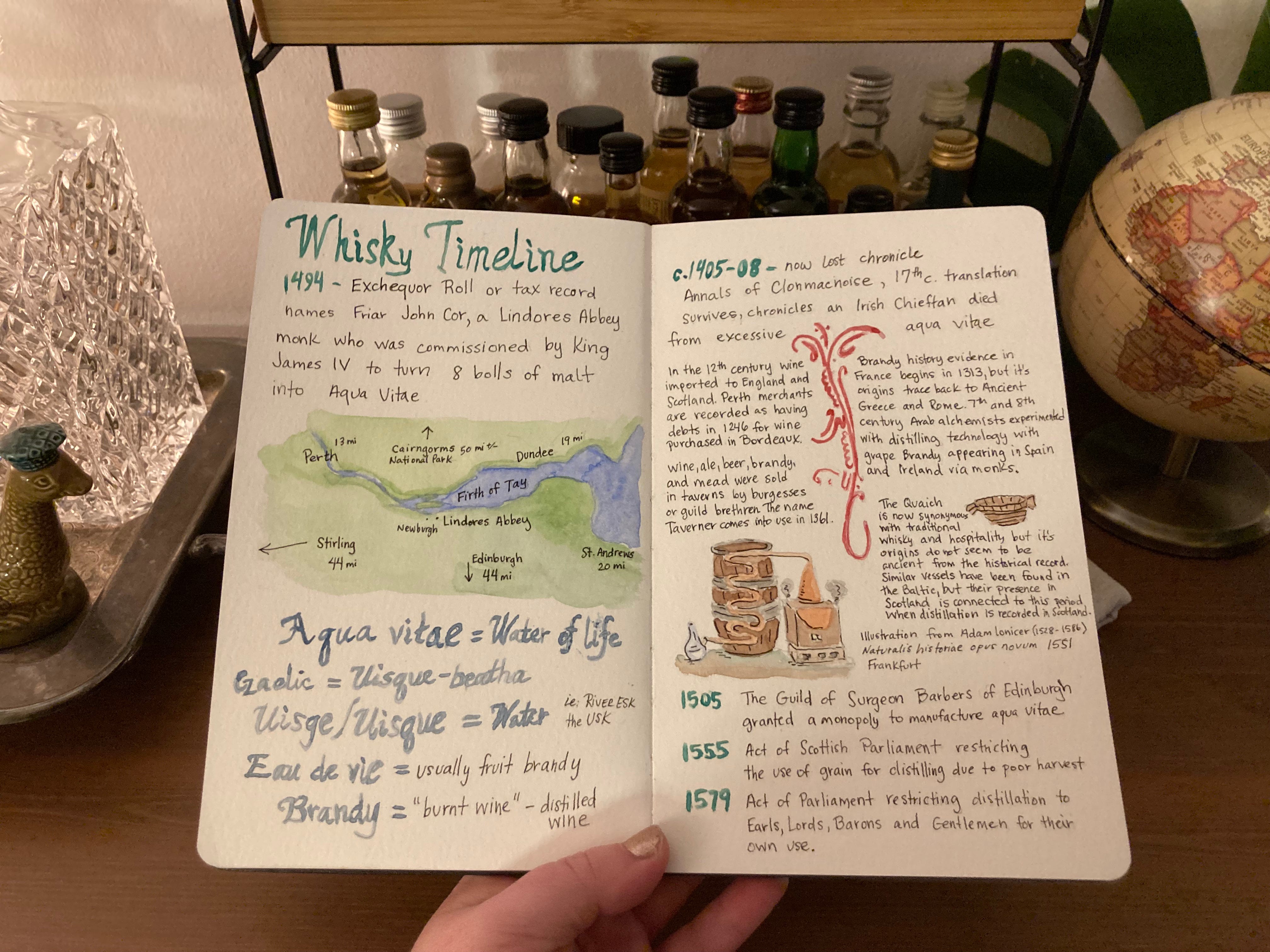
In addition to my thesis research I plan to share excerpts from my research art journal. This was a project I started in 2020 when I was stuck inside missing distillery visits and my local pub. I was compiling my review of the literature written about Scotch whisky and just trying to come to grips with the dearth of information about distilleries, brands, companies, past and present, this journal gave me an outlet for learning that information visually.
Why A Lil Bit Whisky?
When I was trying to brainstorm a name that could represent my research but not just be tied to my time as a PhD researcher, I came up with A Lil Bit Whisky. It’s a bit of a play on business history as it’s “a little bit risky”, it’s also a little bit of a play on my stature - if you remember the picture at the top of the page - I’m not much taller than those letters… I also sometimes let my Southern American accent slip out just a lil’ bit, and finally, I am obsessed with miniature bottles of whisky. I just think they’re so cute. Plus it’s the best way to have a whisky collection when you’re on a student’s budget. If you’ve made it this far, thank you. I hope I haven’t scared you off!